The soaring peaks of the Alps have captivated poets, painters, and explorers for centuries. This vast mountain range, stretching across eight countries, has served as a wellspring of inspiration and wonder. From early travelers who first braved its passes to modern-day artists preserving its memory on digital screens, the Alps remain an enduring symbol of nature’s grandeur and human creativity.
Origins of Alpine Inspiration
Long before Romantic painters and writers ventured into the high valleys, local legends spoke of gods and spirits dwelling among snow-clad summits. By the 18th century, scientific expeditions began mapping the range’s geological features, revealing its twisted rocks and hidden glaciers. Yet it was not only the natural scientists who felt the pull of this majestic terrain. Early tourists wrote travel journals filled with awe; their pages overflowed with descriptions of sheer cliffs, roaring waterfalls, and silent forests.
As roads improved and mountain inns opened, a new breed of adventurer emerged—artists and poets seeking the raw power of alpine vistas. They found in each glacier and ridge a unique dialect of beauty. The Alps, with their alternating zones of green meadows and jagged ice, offered an unparalleled classroom where one could study the extremes of nature. Writers would describe a moment standing above the clouds at sunrise, gazing down at a sublime sea of fog, and painters would chase the way light scudded across snowfields in changing hues.
The Alps in Great Works of Literature
Many of the era’s most celebrated poems and novels owe a debt to the Alpine environment. Percy Bysshe Shelley’s famous verse “Mont Blanc: Lines Written in the Vale of Chamouni” explores the mountain’s power to evoke both human insignificance and spiritual uplift. In his poem, Shelley captures how the mountain can make one feel awestruck, standing on the threshold between earthly concern and cosmic reflection.
Frankenstein’s Gothic Backdrop
Mary Shelley, influenced by visits to Lake Geneva, set dramatic scenes of Victor Frankenstein’s turmoil against the backdrop of alpine storms. The furious whirlwind atop deadly peaks mirrors the scientist’s own inner chaos, suggesting that the natural world can heighten the novel’s gothic intensity. Through her narrative, the Alps become a character in their own right—a cold, unyielding witness to human ambition and tragedy.
Goethe’s Alpine Encounters
Johann Wolfgang von Goethe, one of Germany’s towering literary figures, journeyed through Switzerland and Italy, recording his impressions in travel diaries. His fascination with peaks like the Matterhorn led him to meditate on the contrast between the mortal soul and nature’s eternal rhythms. For Goethe, the Alps were not just a scenic diversion but a source of philosophical inspiration that shaped his thinking on art, science, and the human condition.
Artistic Depictions Across Centuries
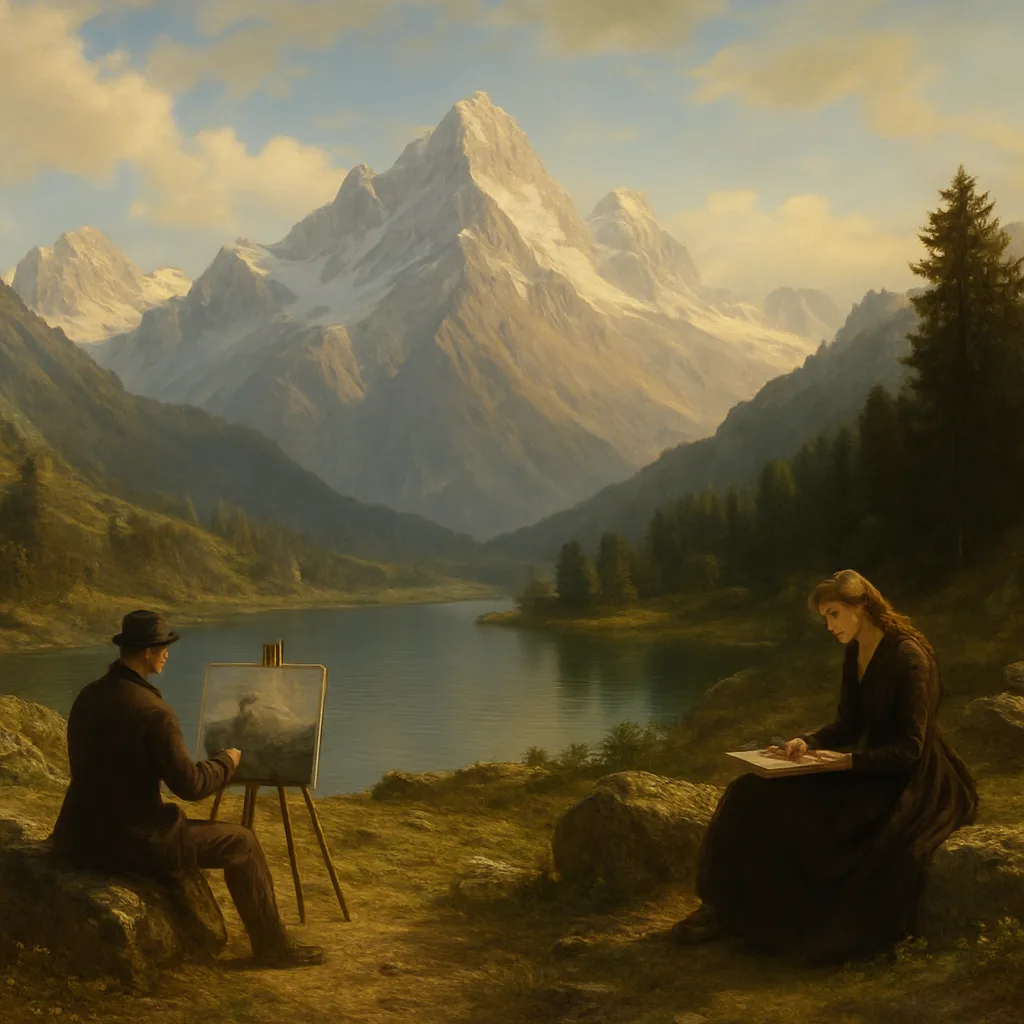
Paintings of the Alps evolved in tandem with advances in artistic style and technology. In the early 19th century, artists of the Düsseldorf school traveled by carriage and horse, sketching rugged panoramas en plein air. Caspar David Friedrich, though more known for northern European landscapes, influenced many Alpine painters with his solitary figures gazing into boundless horizons.
Turner’s Luminous Visions
J.M.W. Turner embarked on Alpine tours, returning home with studies of Mont Blanc and the St. Gotthard Pass. His artworks emphasized the play of light on snow and rock, painting with loose brushstrokes that sought to capture the fleeting effects of cloud and shadow. On his canvas, the Alps become a realm of color where dawn’s first rays ignite icy pinnacles in gold and rose.
Heroic Romantic Landscapes
Other painters embraced the heroic scale of alpine scenery, depicting climbers triumphantly planting flags on remote summits. These images celebrated human conquest of nature, reflecting a belief in progress and mastery. Yet by mid-century, a shift occurred: painters began to emphasize the mystical side of glaciers and crevasses, portraying them as living entities, capable of both beauty and terror.
Contemporary Reflections and Preservation Efforts
In the 20th and 21st centuries, the Alps remain a powerful muse. Photographers armed with digital cameras capture microcosms—tiny ice crystals on pine needles, the delicate bloom of edelweiss, or a single ibex poised on a precipice. Modern writers blend memoir, science, and ecology, crafting narratives that underscore the delicate balance of high-altitude ecosystems.
At the same time, environmental organizations and UNESCO have designated vast stretches of alpine land as protected areas. Climbers, hikers, and scientists now collaborate on sustainable tourism projects, ensuring that trails and refuges leave minimal footprints. In galleries and exhibition halls, immersive installations recreate alpine climates, complete with wind sounds and chill air, reminding visitors of both the beauty and fragility of this high-altitude realm.
Today’s creative tributes to the Alps—whether in film, virtual reality, or street art—draw on centuries of tradition. They build on that original sense of elevation, where human consciousness is lifted by the sheer scale of mountain ridges and the whisper of glaciers. Each brushstroke, stanza, or photograph links back to those first travelers who, at the end of a rugged pathway, looked out at the world from new heights, forever changed by the Alpine view.